
Schedule & Presenters List for the 2026 Kezuroukai USA National Event
Schedule subject to change, and will be updated as we get more information from presenters.
ONGOING DEMONSTRATIONS ARE LISTED BELOW THE TIMED SCHEDULES.
Registration Deadline: Friday, October 16 at 7pm Pacific Time (10pm Eastern Time). Be sure to register before the deadline so you don’t miss out!
Both Saturday and Sunday stations will be set up to assist all skill levels in: sharpening, layout, joinery, saws, chisel, planes and more.
Saturday’s presentations will run from 9:20-5:00, breaking for lunch at 11:40.
Sunday’s presentations will run from 9:20 until we break for lunch at 11:30. Planing competition starts at 4:00 on Sunday!
Kez Saturday after party! With such a busy day Saturday we wanted to have some time to socialize! Stick around after 5:00 for pizza and drinks. (You can pay for pizza on the registration page or in CASH at check-in).
Presenters
Click on the presenter’s name, topic or the + to see their bio and a synopsis of their topic.
Saturday Presentations
From Forest to Finish / Daishuin Zendo
Project scale model to final finish the process of selecting trees in the forest all the way to completion. Working with clients to discover where you can team up to save money without lowering quality of the finishes.
Karl Bareis

Karl Bareis has worked with Japanese carpentry since 1973, beginning with a traditional residential carpentry apprenticeship in Kyoto. His apprenticeship continued in Gifu Prefecture with traditional minka-style building at Yamaishi Komuten of Gujo Hachiman, working with a team to de-construct and rebuild seven farmhouses and convert them into a resort complex—a two-year project.
An introduction to Kiyoshi Yasui of Yasuimoku Komuten in 1977 connected to the American Craft Council which led to trips introducing Japanese culture to American craftspeople. In 1980 Karl was asked by Mr. Yasui to help design and construct two tea ceremony rooms at Hakone Gardens in Saratoga, California.
Other public collaborations include designing and building an 18th-century Japanese farmhouse at the Brattleboro Museum in Vermont as part of an exhibit highlighting traditional building techniques. This was co-sponsored and filmed by the Timber Framers Guild of North America in 1987. Karl has had his own company, Santa Cruz Timberframes, for thirty-three years and designed and built more than forty projects which are influenced by the decades spent in Japan. Karl’s timber frame structures are a sustainable reflection of the forest—focusing on locally harvested trees, specializing in curvilinear beams of madrone and redwood. His portfolio of design-built work is varied—from a Rinzai Zen temple retreat and teahouses to timber frame barns and residences.
Compound Joinery Workshop
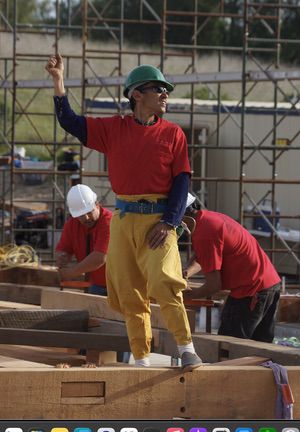
Ryosei Kaneko is doing a compound joinery workshop. Workshop will cover the basic Japanese framing square and Kou, Ko, Gen method. More importantly 3D visualization.
Participants will create their own roof triangles with papers.
Those interested in participating should bring: Japanese framing square, small utility knife, scissors, mechanical pencil or pen 0.3-0.5 point. And an Open Mind.
3D visualization of KOU, KO, GEN framing techniques
Kou (勾): The rise or vertical leg of a right triangle.
Ko (殳): The run or horizontal leg of a right triangle, conventionally set to a fixed base of 10 sun.
Gen (玄): The hypotenuse connecting the start of the run to the top of the rise. [1]
The Framing and Layout Method
Compound Angles: Used when framing complex Japanese roofs or timber joints where timbers meet at oblique or 3D angles.
Sub-triangles: The method divides a unit triangle into smaller proportional triangles by dropping a perpendicular line from the hypotenuse to the 90-degree corner.
Chū-kō (中勾): The dividing red line inside the unit triangle that establishes the geometric relationship for marking cuts.
The Takenaka Museum of Carpentry in Kobe Japan has developed an outreach program that is designed to give children experiences in putting together scale models of Japanese joinery.
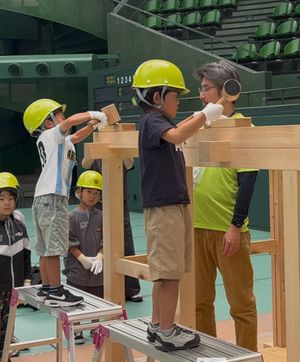
The past few Kezuroukai Japan events have included teams of experts from the Museum who bring three levels of interactive building projects into the public arena provided by the large Kezuroukai events around Japan. Designed to provide activities for youth to spontaneously reconstruct scale model structures especially designed by the museum to challenge and provide true experience in putting together structures. Large enough to climb on and small enough for grade school children to lift into place. The climax of the process is when a team of four children place the so-called down ridge beam into the pre-cut mortices and use mallets to seat the beam.
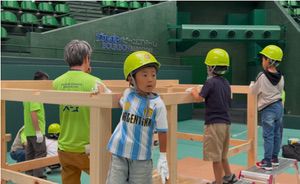
In Japan these model buildings are built and disassembled multiple times during the day. Kids stand in line waiting their turn to be chosen for a “building team”. Instructors teach them to read the grid-system used in real construction. Instructors don’t actually touch the wood pieces. They are stacked in random order into neat piles, the instructors ask the team to find a certain post or beam and the kids find the piece and two of them carry the beam to the area set aside for building. Parents are encouraged to step aside and allow the children space to work together.
This system of encouraging children to participate in building, has been in development for twelve years, and now the traveling museum staff have created designs which piece together with lap joints and tenons tight enough to require mallets to fully seat the joinery. Each group is given twenty minutes (not timed), to build the structure.
This past June, woodcraft instructor David Ballantine traveled to Japan and observed the process. He was given copies of the Takenaka Museum design and has returned to his classroom in Northern California to recreate the timber-frame models. It is our intention to highlight this program inviting David’s high school students to supervise the rebuilding process. Community members plan to put out the word within the community, so we should get involvement from the local Berkeley area community, and we’re asking our members to help bring more youths into the gathering.
San Diego Japanese Friendship Garden Pavilion project
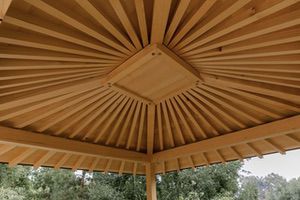
Our latest installation the Azumaya, (an 18′ x 18′ Viewing pavilion with fanned rafters) was completed at the Japanese Friendship Garden and Museum in San Diego, California. The past 12 years we have completed 4 other structures – bridges at the garden.
David Sipos

Minka-Woodworks Inc, was established in 2004 in Ojai, California.
Owner Dávid Sipos has studied furniture making and expanded his knowledge on Japanese carpentry by working with several Japanese carpenters throughout the US and completing numerous timber frame (post and beam) structures, bridges, gates.
His work can be seen in several states including Arizona, California, Georgia, Iowa, Illinois, Maine and New Hampshire in public places and private gardens, residences.
My main focus is on educating the public about the everlasting beauty of Japanese architecture and building structures from sustainably harvested timbers, recycled materials using the traditional joinery and tools.
Restoration projects are under way at several private and public gardens throughout the US. Over the last decade we have completed full restoration projects at the Anderson Japanese gardens in Rockford, IL. The installation of the new railing for the Giboshi bridge was completed in 2024.
Our latest installation was at the Japanese Friendship Garden and Museum in San Diego, CA where we previously have completed 3 bridges and built a 12”x12’ Azumaya, a viewing pavilion this year.
Woodworking as a Practice
The non physical aspect of woodworking is what this talk and hopefully conversation is about. Most, if not all of us have struggled with non technical aspects on our woodworking journey. It often shows up as some kind of resistance, usually in our mind. Let’s explore how we can approach woodworking as a spiritual practice to both improve the work and our lives.
Yann Giguère

Giguère has been a professional woodworker since 1991 and founded Mokuchi Studio in 2008. His training began with Western woodworking in Fairfield, Iowa. He quickly found inspiration in the Japanese woodworking traditions and hand tools. In 1999, he focused on Japanese techniques by entering a 9-year apprenticeship at the Takumi Company in Seattle with acclaimed woodworker Dale Brotherton. Giguère’s work is unique in the Japanese techniques used for complex joinery and elegant hand-finishing. His design and build experience includes entire timber frame homes, interior features ranging from stairs and shojis to cabinetry, garden structures, and furniture. He is a passionate educator on Japanese tools and techniques.
Website: mokuchiwoodworking.com
Instagram @mokuchistudio
Pizza Get-Together on Saturday at 5pm after the day’s event, at the Community Center. $20. registration page or in CASH at check-in.
Bring Your Own Drink.
Demonstrations
All of the demonstrations listed below will be “on-going” all weekend in the sense that there will be dedicated stations for each and the demonstrators will generally be on hand to interact with participants. Demonstrators will of course take breaks periodically to get a drink, view other demonstrations/presentations, etc.
Some of these demonstrations will also have a time slot scheduled for Sunday when the demonstrator will give a brief introduction/talk about the work they are doing at their station.
Interactive Model Timber Frame for Kids Sunday 10:30am-2pm
Blacksmithing
Location: outdoor forge station
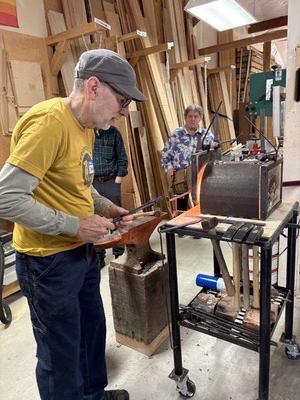
My forge is a traditional Japanese charcoal trench forge used for general toolmaking and swords (I don’t make swords). I use a box bellows (fuigo).
Dave’s skill at forging tools comes from the knowledge passed down from his teacher. Needless to say that without craftsmen able to forge top-quality steel blades, the kezuroukai movement wouldn’t exist.
Dave’s demonstration will be something everyone should see, and his knowledge of myriad carpentry tools will help us better define our own skills.

Dave Burnard has apprenticed with Japanese tool makers, and he makes tools with a traditional Japanese charcoal trench forge at his workshop in Oregon.
HATSURI-KI. Hewing timbers
Location: outdoor hewing station
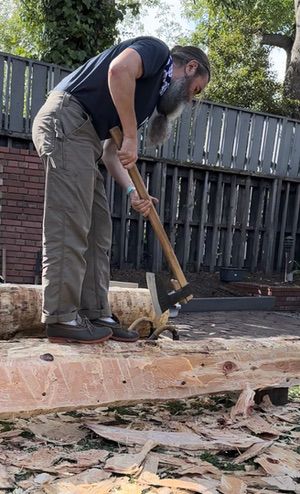
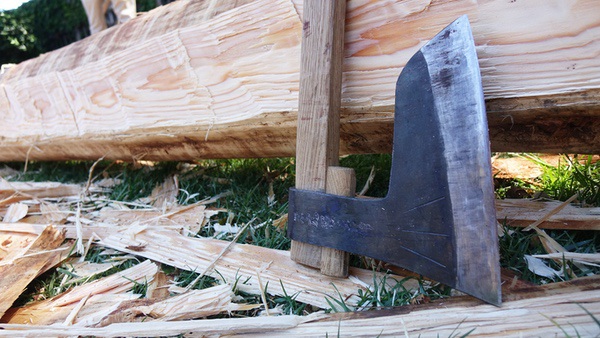
Yann Giguere will be coming down from Oregon with his masakari broadaxe (鉞), and our Kezuroukai organization will provide space and fresh cut logs for those interested in swinging their tools. The craft of hatsuri nearly dyed out in Japan–down to a few pockets where red pines flourished and traditional minka houses were still being built from local forests.
Beginning in 2005 several hewing masters gathered in the Echizen area of Japan to demonstrate their craft. That first gathering spawned a growing movement in Japanese hewing.
Yann has taken up the craft and over the past ten years has traveled far and wide to teach hewing and other traditional jikugumi techniques.
We will go over the two main approaches to hewing as well as how to read logs and layout for hewing. People will be offered a chance to try for themselves the tools and methods.
If you have a hewing tool or two or three, please bring them along and let’s put them to use. If your hewing tools are not working well, all the more reason to bring them. We can sharpen them and tweak their set up.
Yann Giguère

Giguère has been a professional woodworker since 1991 and founded Mokuchi Studio in 2008. His training began with Western woodworking in Fairfield, Iowa. He quickly found inspiration in the Japanese woodworking traditions and hand tools. In 1999, he focused on Japanese techniques by entering a 9-year apprenticeship at the Takumi Company in Seattle with acclaimed woodworker Dale Brotherton. Giguère’s work is unique in the Japanese techniques used for complex joinery and elegant hand-finishing. His design and build experience includes entire timber frame homes, interior features ranging from stairs and shojis to cabinetry, garden structures, and furniture. He is a passionate educator on Japanese tools and techniques.
Website: mokuchiwoodworking.com
Instagram @mokuchistudio
Japanese Finger Planes – Chibbi Kanna
Location: Scott’s demonstration station

I will demonstrate the making of a Japanese style finger plane, and the special techniques used to make it. I will talk about how to select wood for the dai (or block), how to select appropriate blade angles, the geometry of the dai, and how to layout and cut the dai. Importantly I will show how to prepare the special blade stock that is commonly used in these planes. If time allows I will show how to layout and cut a dai for a compass plane, a hollow or round plane, and a spoon bottom plane, and shape the blade.
Scott Wynn

I am a professional woodworker and have been using Japanese planes professionally since 1974. In 1983 I was taught the technique of making Japanese planes and chibbi-kanna by an apprentice of Master Japanese woodworker Kenkichi Kuroda son of National Treasure Tatsuaki Kuroda. This apprentice was Howard Lazzarini, who had traveled from Japan with another member of Kuroda’s workshop to teach a seminar on making planes for your own use. I have been making them as needed ever since.

Over the years I have made about 25 Japanese planes in a wide variety of sizes; from 10mm blades to 75mm blades, as needed for use in my own work; and have set up, and/or modified around 70 Japanese planes that I use in my own work.
I have written 5 books on handplanes including “Discovering Japanese Handplanes”.

In June, woodcraft instructor David Ballantine traveled to Japan and observed the interactive model timber frame assembly process. He was given copies of the Takenaka Museum design and returned to his classroom in Northern California to recreate the timber-frame models. Sunday’s event is highlighting this program— 8 of David’s high school students will supervise the re-building process. This is a great chance for kids to participate in putting together a structure.
This system of encouraging children to participate in building has been in development for 12 years in Japan. Takenaka Museum staff have created designs which piece the structure together with lap joints and tenons tight enough to require mallets to fully seat the joinery. Each group is given twenty minutes (not timed), to build the structure.
In Japan these model buildings are built and disassembled multiple times during the day. Kids stand in line waiting their turn to be chosen for a “building team”. Instructors teach them to read the grid-system used in real construction. The pieces are stacked in random order into neat piles. The instructors ask the team to find a certain post or beam and the kids find the piece and two of them carry the beam to the area set aside for building. Parents are encouraged to step aside and allow the children space to work together.
JP Li – Horimono – Hanagawara – carved end cap (Chu Mon gate at Hakone Gardens)
Location: horimono display station
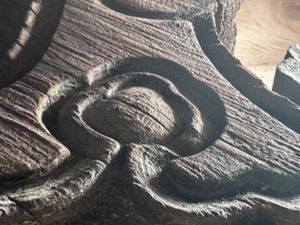
HORIMONO – Carving the Hakone Ridge Cap
Traditional Japanese wood carving (horimono) is an ancient craft focused on subtraction, precision, and deep spiritual expression. Beginning in 2024 Kez volunteers have been replicating the 90 year old ridge cap on the Chu Mon entry gate. The Nishiura brothers who built the Chu-mon gate at Hakone Gardens didn’t have access to ornate high-fired oni-gawara tiles in ’30’s California, so they designed a unique wooden end cap for the gate ridge.
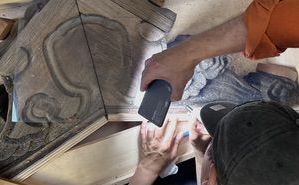
For ninety years this large redwood carving rested high above the ground. When the gate was refurbished in 2023 the ridge cap was taken down to be preserved, and it was determined that the original carving’s condition was too fragile. Our group decided to study the original carving and figure out if we could copy the original carvings and successfully replace them on the historic gate. After months of work and practice the carvings will be on-view during this year’s Kezurou-kai event.
J.P. Li will set up the ridge cap at the event and discuss the process.
Saw Tooth Touch-Up
Location: sawing station
Jay van Arsdale

Jay van Arsdale apprenticed early on in his family’s blacksmith shop in Kentucky. After graduating from Centre College in nearby Danville, Ky, Jay came to the SF Bay Area where he received an MFA in sculpture from Mills College in Oakland, CA in 1972.
Things came into focus in the mid-1970’s after seeing a demonstration by Japanese daiku Makoto Imai, who Jay learned from for a number of years.
Jay has worked and taught in the Bay area since the early 80’s. He has given demos/lectures and other presentations for many organizations including the Japan Society, San Francisco Asian Art Museum, the Exploratorium, Academy of Science, UC Berkeley School of Architecture, North American Timberframers Guild West Coast Conferences and numerous national wood working shows.
Jay is also the author of Shoji–How to Design, Build, and Install Japanese Screens, (Kodansha, ‘86), Introduction to Japanese Woodworking (video,’ 87) , and contributing editor on The Complete Japanese Joinery, (Cloudpress ‘89). He also has written numerous magazine articles, produced multiple instructional videos, and appeared on TV in Japan and the U.S.
Dave Burnard has apprenticed with Japanese tool makers, and he makes tools with a traditional Japanese charcoal trench forge at his workshop in Oregon.
Location: chopstick making station
Location: Eric’s demonstration station
Eric Baker

Eric Baker is a seed planter. A lifetime carpenter whose goal is to cover California in Japanese hand tool fundamentals. And in the process, create space for bigger things to happen. Eric is a founding member and director of Hida Tool School, a monthly, grassroots introduction, to the beautiful world of hand tools.
Location: outdoor yaki sugi station
Location: mallet making station
Making to-ishi dai–sharpening stone stands (sharpening stone holder). (Hands on activity)
Location: Making sharpening stone holders
I will have an ongoing station for making to-ishi dai–sharpening stone stands (sharpening stone holder).
Anandamayi is a professional artist. She has been studying Japanese Joinery at Laney college since 2020, and has been assisting there as a TA for several years. She is eager to share her relatively new love of hand tool woodworking with other interested beginners with the hope that they will be emboldened to try their own small projects.
Kanna shiage (hands on station)
Location: kanna shiage station
Jason Forster

Jason started his woodworking career as an apprentice to Oakland daiku Jay van Arsdale, building over 70 bonsai display benches for the Bonsai Garden at Lake Merritt. Prior to becoming a woodworker, Jason was a postdoctoral fellow in materials science at Lawrence Berkeley National Laboratory. He holds a Ph.D. in soft matter physics from Yale University, where he researched the structural color of bird feathers. He holds several patents related to thermoelectricity and nanoscience.
Prior to his nomination to the board, Jason has been an active member of Kezurou-kai USA since he attended his first meeting in 2015. Since then, he has participated as a presenter and competitor at every national event. He spends his Saturdays working as adjunct faculty alongside Jay at Laney College in Oakland teaching one of the only programs in Japanese woodworking and hand tools offered at the college level anywhere in the world.
In 2018, Jason and another Bay Area carpenter completed the installation of an original-design machiai in the Japanese Hill and Pond Garden at the Brooklyn Botanic Garden. He continues to work as a carpenter with Hermitage Woodworks in Richmond, CA.
Jason joined the Board of Directors in 2021.
Location: yariganna station
Joinery
Location: joinery station
Jay van Arsdale
Jay van Arsdale apprenticed early on in his family’s blacksmith shop in Kentucky. After graduating from Centre College in nearby Danville, Ky, Jay came to the SF Bay Area where he received an MFA in sculpture from Mills College in Oakland, CA in 1972.
Things came into focus in the mid-1970’s after seeing a demonstration by Japanese daiku Makoto Imai, who Jay learned from for a number of years.
Jay has worked and taught in the Bay area since the early 80’s. He has given demos/lectures and other presentations for many organizations including the Japan Society, San Francisco Asian Art Museum, the Exploratorium, Academy of Science, UC Berkeley School of Architecture, North American Timberframers Guild West Coast Conferences and numerous national wood working shows.
Jay is also the author of Shoji–How to Design, Build, and Install Japanese Screens, (Kodansha, ‘86), Introduction to Japanese Woodworking (video,’ 87) , and contributing editor on The Complete Japanese Joinery, (Cloudpress ‘89). He also has written numerous magazine articles, produced multiple instructional videos, and appeared on TV in Japan and the U.S.
Location: sharpening station
Location: sawing station
This is a friendly Competition to test handplaning skills. The thinnest full length and width shaving wins. Sign up to compete or just enjoy the show!